
Why a quiet, outdated repository teaches more real engineering than the biggest curated lists on GitHub.
If you have been learning programming for a while, chances are your GitHub account looks a lot like mine once did: dozens of starred repositories, beautifully organized folders of tutorials, and maybe even a few “ultimate learning roadmaps” saved on your desktop.
You star everything that looks useful.
You bookmark every promising resource.
You feel productive — until you try to write actual code.
Here’s the uncomfortable truth most beginners eventually face:
Starring 100 GitHub repos doesn’t make you a developer. Building even one real project does.
Let’s talk about why that happens — and why an “outdated” GitHub repo might be the key to escaping tutorial hell.
The Beautiful Repos We All Star (But Rarely Use)
If you’ve spent any time on GitHub, you’ve probably starred these classics:
Awesome — the giant index of tutorials, tools, and curated resources.
TheAlgorithms — algorithms in every language, perfect for cross-language comparison.
free-programming-books — the largest free CS library on GitHub.
system-design-primer — the go-to guide for system design and scalability.
front-end-checklist — a practical pre-launch checklist for frontend work.
OSSU CS — a free, MIT-style computer science curriculum.
They’re all excellent.
I recommend every one of them.
But they share the same limitation:
They tell you what to learn — not how to learn it.
And that second part is exactly where most beginners struggle.
The Hidden Reason 82% of Beginners Quit Programming
A study across multiple coding education platforms shows a painful statistic:
Over 82% of beginners quit within their first 90 days.
Not because programming is impossible.
But because beginners fall into the same trap:
- Collect tutorials
- Collect GitHub repos
- Watch videos
- Save roadmaps
- Read documentation
…and write almost no real code.
It feels productive.
It looks like learning.
But internally, nothing is being built.
You end up with:
- 20 browser tabs open
- 10 new GitHub stars
- and a half-functional demo that won’t start
The problem isn’t motivation.
It isn’t intelligence.
It’s the learning method.
Most tutorials teach you to consume, not to create.
Then I Found a Repo That Looked “Outdated”…
…and it changed everything.
Between all the shiny, trending, frequently updated projects, I stumbled upon something unexpected:
project-based-learning
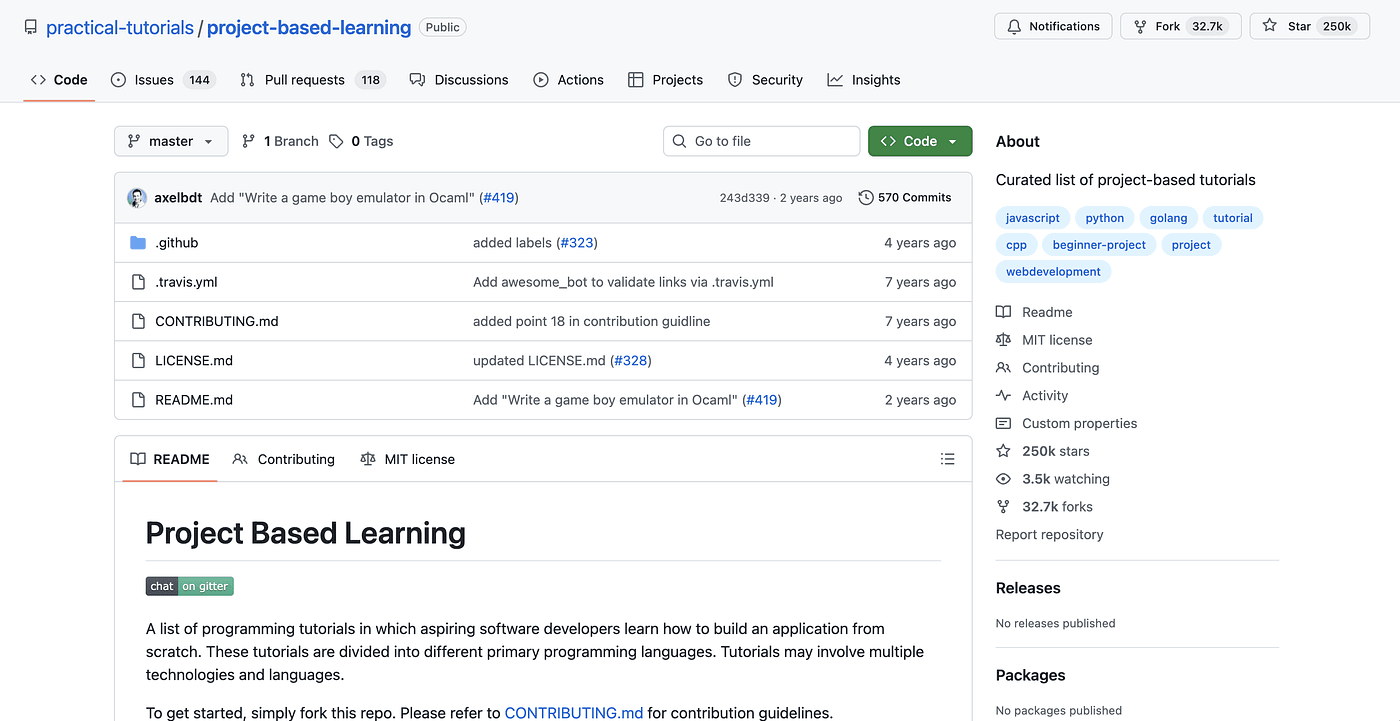
At first glance, it looked abandoned:
The last update was two years ago.
But as I scrolled further, I realized:
This is one of the most practical, underrated learning resources on GitHub.
Because unlike most learning repos, this one doesn’t collect knowledge —
it collects projects.
Small, focused, runnable projects designed to pull you into real-world programming from day one.
The Core Principle: Practice-Driven Learning
This repository follows one philosophy that many CS graduates only discover years later:
Build → Understand → Then learn the theory
It flips traditional learning on its head:
No syntax drills
No concept memorization
No “Hello World” repetition
No endless lectures
Instead:
- Build a small web server → then understand networking
- Build a key-value store → then understand memory models
- Build a markdown parser → then understand recursion and tokenization
- Build a compiler → then understand language design
This is the approach that turns you from a beginner who “knows things”
into an engineer who understands things.
Why “Reinventing Wheels” Is the Fastest Way to Grow
You’ve probably heard this phrase:
“Don’t reinvent the wheel.”
That’s true in production engineering.
But in learning?
Reinventing wheels is the shortcut.
When you build:
- a mini HTTP server
- a tiny database
- a JSON parser
- a REST client
- a simple shell
You suddenly understand:
- how memory works
- how state machines are designed
- why concurrency leads to bugs
- how network I/O behaves
- what protocols really represent
- why frameworks look the way they do
No tutorial can give you these insights.
They only come from constructing things yourself.
And this is exactly the learning path that project-based-learning provides.
The Big Repos Give You the Map — Not the Path
Let’s be clear:
All the famous repositories are excellent.
They’re valuable.
You should keep them.
But here’s the truth:
- Awesome gives you the map
- TheAlgorithms gives you technical clarity
- free-programming-books gives you free resources
- system-design-primer gives you architectural depth
- OSSU gives you a full CS curriculum
But none of them tell you where to start
or how to actually move from level 0 to level 1.
project-based-learning fills that gap: It gives you a path you can actually walk — project by project.
Why This Repo Never Goes Out of Date
Technology moves fast.
Frameworks change every year.
Tools rise and fall.
Trends come and go.
But the foundations?
They’re the same as they were 20 years ago.
- To understand systems → learn C
- To understand machines → learn Linux
- To understand software → learn data structures & algorithms
- To understand architecture → learn distributed concepts
And most importantly:
To understand engineering, you must build systems — not memorize definitions.
This is why project-based-learning remains relevant,
even without weekly updates or flashy marketing.
Its principles are timeless.
Final Thoughts: The Most Stable Path From 0 to 1
The hardest part of learning programming is not the concepts.
It’s staying motivated long enough to complete something real.
And nothing builds motivation like making your own code run.
That’s the magic of project-based-learning.
If you’re lost, overwhelmed, or unsure where to start:
Pick one small project.
Build it.
Finish it.
You’ll learn more from one working project
than from a hundred starred repositories.
This is the fastest, most stable, most effective path
for beginners to grow into real engineers.